Dear friends,
To accompany this Holy Week, we want to share a brief biography of Blessed Carlo Gnocchi, a man who was no stranger to participating in Christ’s Passion, and to offer a reflection on his work “The Pedagogy of Innocent Suffering.”
An Introduction to the Life of Blessed Carlo Gnocchi
Carlo Gnocchi was born on October 25, 1902, in San Colombano al Lambro, a small town in the province of Lodi in Italy. The third child of Enrico, a marble craftsman, and Clementina, a dressmaker; he grew up in a modest family marked by early suffering: his father died when he was only five years old, and shortly thereafter, tuberculosis also took his two brothers, Mario and Andrea. His mother, widowed and alone, moved with little Carlo to Milan, where she tried to rebuild a future for both of them.
From childhood, Carlo showed a deep spiritual vocation. He entered the seminary under the guidance of Cardinal Andrea Ferrari and, despite his fragile health, was ordained a priest in 1925 by Archbishop Eugenio Tosi, celebrating his first Mass in Montesiro, a place very dear to him.
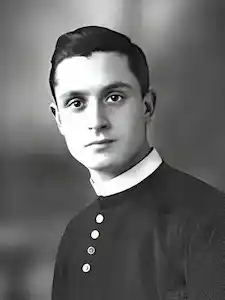
His first pastoral assignment was as an assistant in an oratory and then in the Milanese parish of San Pietro in Sala, where he soon won the appreciation of the community for his dedication to education and his affable character. In 1936, Cardinal Alfredo Ildefonso Schuster appointed him spiritual director of the Gonzaga Institute, one of the most prestigious schools in the city, entrusted to the Brothers of the Christian Schools. At the same time, he devoted himself to pedagogical studies and published several short essays.
In the following years, Schuster entrusted him with the spiritual care of the university students of the Second Legion of Milan, which consisted of mostly students from the Catholic University and former students of Gonzaga. When Italy entered World War II in 1940, many of those young people were called to arms. Don Carlo, moved by a deep sense of educational responsibility, decided to accompany them to the front as a volunteer chaplain for the Alpine troops of the “Val Tagliamento” battalion, leaving for the Greek-Albanian campaign.
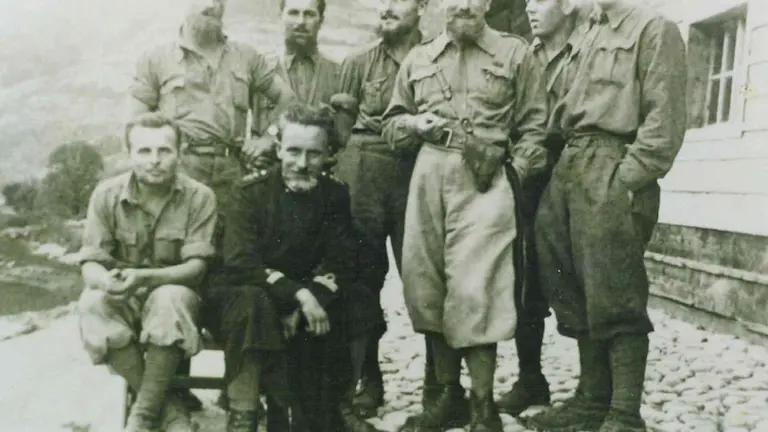
It was during the tragic retreat of January 1943 that he had one of the most dramatic and decisive experiences of his life: exhausted, he was on the verge of dying in the snow, but was saved by some comrades who carried him away on a sled. During those days, surrounded by wounded and dying young men, the idea germinated within him that after the war he would devote himself entirely to the care of the weakest.
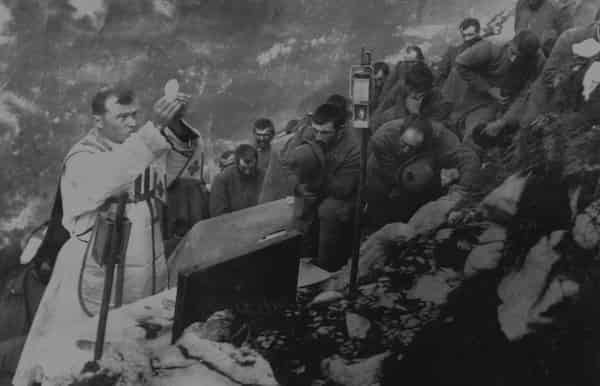
Back in his homeland, he embarked on a long and moving journey through the mountains in search of the families of the fallen, to bring them comfort.
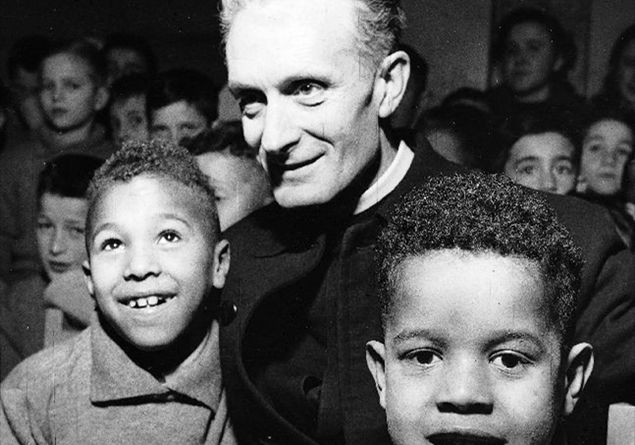
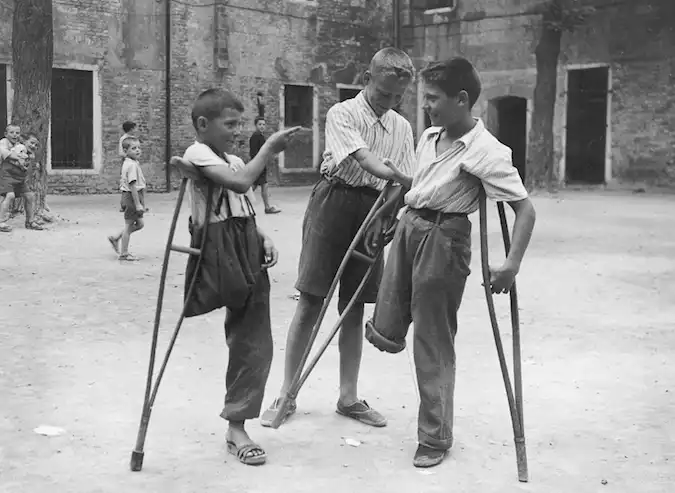
With the end of the conflict, he began to give a more concrete form to the dream born on the front lines: to offer shelter and care to children maimed by war. He took over the management of the Institute for the Severely Disabled in Arosio, where he welcomed the first “mutiladitos” (maimed children) and orphans. The center soon filled up, and in 1947 Don Gnocchi managed to rent a large house in Cassano Magnago, which became a new reference point for his work.
He founded homes for the welfare of these young people and children; Don Carlo implemented an innovative model: not only shelter and assistance, but also medical rehabilitation, education, and vocational training, at a time when rehabilitation medicine was still in its infancy.
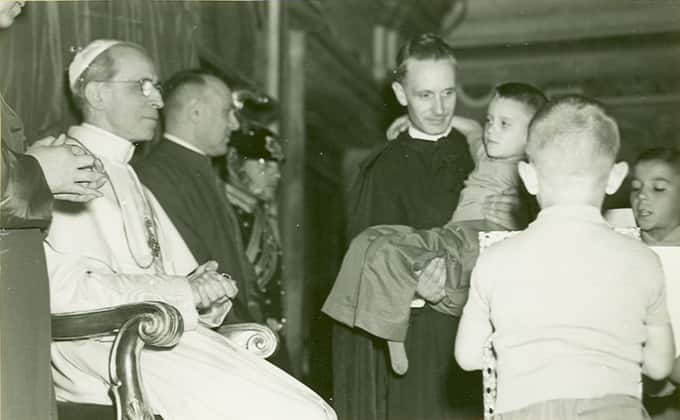
However, Don Gnocchi, already seriously ill, did not live to see his work completed. He died on February 28, 1956, at the Columbus Clinic, from a tumor.
He was beatified on October 25, 2009. His remains rest in the church that bears his name in Milan.
Pedagogy of Innocent Suffering
Pain poses many profound problems for the human mind, even when it is enlightened by faith, but certainly one of the most delicate and disturbing aspects is its apparent capricious distribution among men.
It is easy and almost natural to admit/think that pain is punishment and atonement for guilt, and should mainly befall those who have sinned most gravely.
But instead, we often see the opposite: sinners triumph and the righteous suffer, often because of their very righteousness.
The most disturbing of all examples is the case of children who suffer.
Our expressions are: My God, why do you make this innocent child suffer? Why don’t you strike me, who am a sinner? Or, on the part of a child: Why do you make me suffer? I didn’t do anything wrong!
It is worth studying this case because when one comes to understand the meaning of children’s pain, one has in one’s hand the key to understanding all human pain, and whoever manages to sublimate/transcend the suffering of the innocent is in a position to console the pain of every man struck and humiliated by pain.
Objections to pain arise from an exclusively individualistic and punitive conception of pain:
- Objectors believe that suffering in man is a totally personal matter and a rigorous expiation measured by individual faults. But nothing could be further from the truth in the Christian conception of reality.
In Christian economics, humanity forms a living unity, solidly united in a single and identical destiny, sharing in the good and evil of each of its members; a mystical body that follows the same laws as the physical body, where health and sickness, well-being and discomfort, life and death are common to all men.
Adam rebelled against God, and all men have rebelled “at root” with him; Adam was punished with the burden of work and pain, and all men must equally bear the cross of fatigue and suffering with him.
- The reason for a child’s suffering: He suffers as a man/person, therefore, because they are a member of humanity, they share responsibility at the root for original sin and therefore are associated with its secular expiation.
A harsh law, yet mysteriously just.
- The justification for the pain of an innocent child is found in his irrevocable solidarity with Adam.
Children also atone for their share of the personal mistakes and sins committed by all men (a reason that should serve as a restraint whenever a man is tempted to sin).
So far, pain has been discussed solely as punishment and atonement for guilt. However, it is also part of the Redeemer’s work of renewing and restoring human values that he has given pain the positive character of purification and redemption from sin. In this way, through pain, redeemed man can not only cancel his condemnation but also conquer and deserve the reward of a full and unfailing life.
“I fill up in my flesh what is lacking in the Passion of Christ” (Col 1:24), yet not all human sufferings have the same degree of affinity with those of Christ.
On the one hand, there is the suffering of the sinner, which must be offered (at least in part and in the first place) for the redemption of his personal sins; on the other hand, there is the suffering of the righteous, which is directed instead toward redeeming and expiating social sins.
The prototype of this suffering is Christ, the innocent and most pure Son of God, who dies for the redemption of mankind. An example of this is the suffering of children and of the saints, who also suffer for the purification and salvation of their brothers and sisters.
It is necessary to be convinced that nothing is more real or more practical than these mystical laws of suffering.
If, according to the Gospel, pain reveals the presence of Christ in man, in no one else is this transparency clearer, more evident, and more immediate than in a child. And that is why Jesus said, “Whatever you do to one of these little ones, you do to Me” (Mt. 10:42).
The suffering of a child purifies and redeems, according to the loving law of Christ, a living sacrifice of innocent humanity for sinful humanity. We must see not only a little human redeemer with Christ and in Christ, but also an intercessor and mediator of grace, by virtue of the irresistible power of application and impetration that innocent pain has on the heart of God.
Every child who suffers is therefore like a precious little relic of Christian redemption, which is acted upon and renewed in time to atone for daily sins, worthy of being honored and even venerated, such as towards Saint Leonidas the martyr, when he bent down every morning to kiss the heart of his little son, recognizing and adoring in his chest the Trinity present and at work.
How important and urgent it is, therefore, for all those who are in charge of and responsible for souls to become aware of this duty. But men, despite being so solicitous in valuing material treasures and blind to the forces of earthly powers, do not concern themselves with valuing the spiritual treasures hidden in the souls of the innocent, nor do they believe sufficiently in their decisive value!
This pedagogy is not reserved only for times of great pain and serious cases of suffering in children, so that it should only be considered and practiced by doctors, religious, or family members who are dedicated to the care of sick or disabled children. Its principles and criteria apply at all times of suffering, even if/when they are temporary.
Nor should it be said that children are not prepared to understand, live, and act on these delicate truths of the supernatural economy, because this is an error.
Christian teaching on pain aims above all to teach children in a practical way that they should not keep their pain to themselves, but that they should offer it to others and that pain has great power over the heart of God. Examples include offering pain for a missionary, for the Pope, for poor children, etc.
When a child has come to understand the similarity between his pain and that of Christ and his duty to imitate the behavior and feelings of Jesus in moments of pain, he will have touched the deepest and most unexplored center, the original and operative center of all Christianity, the virginal point of Christ’s doctrine.
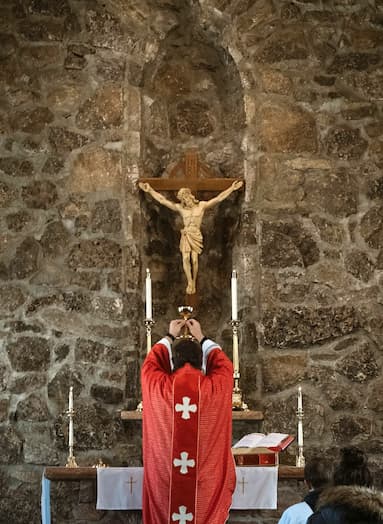
In the daily Holy Mass, where the river of divine blood is enriched by the confluence of human pain, it is in the divine river that every drop of human suffering and tears acquires the supernatural value of redemption and grace.
The struggle against pain is not, however, only a complement to human generation, but also a complement to Christian redemption. Christ’s redemption cannot be limited to the restoration of divine grace, but must also extend its benefits—as far as possible and useful for the purposes of purification and personal sanctification—to the aforementioned material consequences of original sin. Therefore, it must also aim to heal or at least alleviate physical pain and combat all its causes.
Healing pain is not only a work of philanthropy but a work closely linked to Christ’s redemption, inasmuch as it puts its benefits into action and extends liberation also to the material realm, tending to restore the harmony, order, and well-being that man enjoyed before the original fall and to which he tends towards with all the forces of his being.
The pain of the innocent, in the mysterious Christian economy, also occurs for the manifestation of the works of God or those of man: works of science, piety, love, and charity.
Discover more from Friends of the Cross
Subscribe to get the latest posts sent to your email.