“I suddenly remembered to make
that sacrifice to console Our Lord.”
Saint Francisco Marto
Dear Friends of the Cross,
We are in the month of May, in which we remember the Blessed Virgin Mary in a special way. If devotion to the Blessed Virgin Mary, Mother of God and Mother of our Saviour Jesus Christ, is of great importance for every Christian, it should be even more so for the ‘Friends of the Cross’, but why? Because as a good Mother she accompanied her son, Jesus Christ, in the fulfilment of the Father’s will until death and death on a cross.
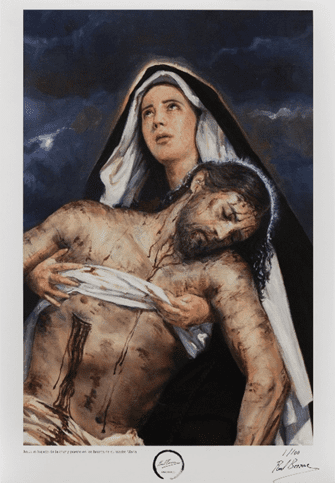
The Catechism of the Catholic Church teaches us:
“The Blessed Virgin advanced in her pilgrimage of faith, and faithfully persevered in her union with her Son unto the cross. There she stood, in keeping with the divine plan, enduring with her only begotten Son the intensity of his suffering, joining herself with his sacrifice in her mother’s heart, and lovingly consenting to the immolation of this victim, born of her: to be given, by the same Christ Jesus dying on the cross, as a mother to his disciple, with these words: Woman, behold your son.” (LG 58).“ [1]
In this moment of sorrow, for both the hearts of Mother and Son, we have received Mary as Mother: yes, Mother of Jesus and now Mother of all Christians. As she accompanied her Son, she now accompanies us and each one of us in particular. We can look at the protection of Mary in her various ways throughout history, think of Loreto, Częstochowa, Pilar, Lourdes, Altöting, Heiloo, Fatima, etc.
We would like to highlight in this bulletin the effects the apparitions of the Virgin Mary in Fatima and the apparitions of the Angel of Portugal to the shepherd children.
All the apparitions had a clear message for the children, at the moment we are mainly interested in two texts:
The second appearance of the angel:
This is what is asked: Offer prayers and sacrifices constantly to the Most High!
And here the little shepherds teach us an important question that we should often ask ourselves: How are we to make sacrifices?
Let us meditate on the angel’s answer. Make of everything you can a sacrifice, and offer it to God as an act of reparation for the sins by which He is offended, and in supplication for the conversion of sinners.
You will thus draw down peace upon your country. I am its Angel Guardian, the Angel of Portugal. Above all, accept and bear with submission, the suffering which the Lord will send you.” [2]
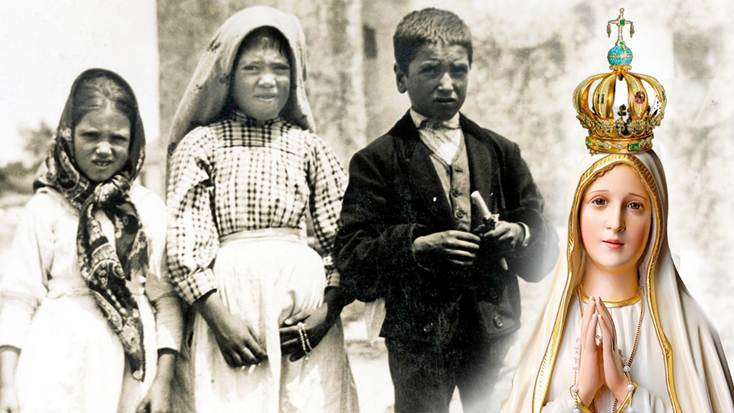
The 2nd apparition of the Blessed Virgin on 13 June 1917:
According to Lucia’s account:
– What do you want of me? I asked.
– I wish you to come here on the 13th of next month, to pray the Rosary every day, and to learn to read. Later, I will tell you what I want. I asked for the cure of a sick person.
– lf he is converted; he will be cured during the year.
– I would like to ask you to take us to Heaven.
– Yes. I will take Jacinta and Francisco soon. But you are to stay here some time longer. Jesus wishes to make use of you to make me known and loved. He wants to establish in the world devotion to my Immaculate Heart.”
-Am I to stay here alone? I asked, sadly.
-No, my daughter. Are you suffering a great deal? Don’t lose heart. I will never forsake you. My Immaculate Heart will be your refuge and the way that will lead you to God.
As Our Lady spoke these last words, she opened her hands and for the second time, she communicated to us the rays of that same immense light. We saw ourselves in this light, as it were, immersed in God. Jacinta and Francisco seemed to be in that part of the light which rose towards Heaven, and I in that which was poured out on the earth. In front of the palm of Our Lady’s right hand was a heart encircled by thorns which pierced it. We understood that this was the Immaculate Heart of Mary, outraged by the sins of humanity, and seeking reparation.” [3]
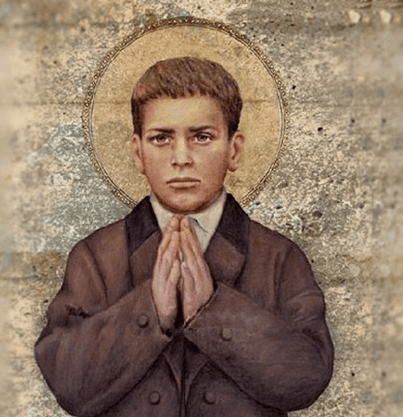
Using the text of the homily of St. John Paul II on the occasion of the beatification of Jacinta and Francisco, we explain the effect that these messages have had on the life of Francisco: “Later Francisco, one of the three privileged children, exclaimed: ‘We were burning in that light which is God and we were not consumed. What is God like? It is impossible to say. In fact, we will never be able to tell people. ‘
What most impressed and entirely absorbed Bl. Francisco was God in that immense light which penetrated the inmost depths of the three children. But God told only Francisco ‘how sad’ he was, as he said. One night his father heard him sobbing and asked him why he was crying; his son answered: ‘I was thinking of Jesus who is so sad because of the sins that are committed against him’. He was motivated by one desire – so expressive of how children think – “to console Jesus and make him happy’.
A transformation takes place in his life, one we could call radical: a transformation certainly uncommon for children of his age. He devotes himself to an intense spiritual life, expressed in assiduous and fervent prayer, and attains a true form of mystical union with the Lord. This spurs him to a progressive purification of the spirit through the renunciation of his own pleasures and even of innocent childhood games.
Francisco bore without complaining the great sufferings caused by the illness from which he died. It all seemed to him so little to console Jesus: he died with a smile on his lips. Little Francisco had a great desire to atone for the offences of sinners by striving to be good and by offering his sacrifices and prayers. The life of Jacinta, his younger sister by almost two years, was motivated by these same sentiments.”[4]
In the third apparition Our Lady asks the children: “Sacrifice yourselves for sinners, and say many times, especially whenever you make some sacrifice: O Jesus, it is for love of You, for the conversion of sinners, and in reparation for the sins committed against the Immaculate Heart of Mary.”
“Where do we find the theological grounds for such a concern?
It is in the Gospel, in one of the most impressive scenes: as Jesus went to the Garden of Olives, he chose the three closest apostles to watch and pray with him; and they fell asleep. Even today pious souls love to keep the Lord company, remembering His agony in the Garden. Pascal said that Christ will be in agony until the end of the world.
The three apostles who slept in the Garden were not alone. With them were all the good souls, more or less conscious, more or less awake, who keep agonising Jesus company. This is the kind of reparation that we can do now, with an awareness that rises beyond time and takes on the characteristics of eternity. The little shepherds of Fatima had not studied theology, but they were enlightened by the gifts of the Holy Spirit. It is not necessary to know theology to arrive at the intuition that sin offends God, and that the good comforts him. This is the great lesson of Francisco Marto.”[5]
We would like to conclude this article with one of St. Francisco Marto’s little flowers so that we may imitate him and offer our small daily sacrifices for the love of God:
“One day, on our way home, we passed in front of my godmother’s house. She had just made distillation mead and called out to us to give us some. We went in and it was to Francisco that she first offered a glass. He took it and without drinking, passed it to Jacinta, so that she could drink with me first, while he turned and disappeared.
-Where is Francisco,’ asks my godmother.
-I don’t know, I don’t know; he was just here.
He didn’t appear. Jacinta and I thanked her for her kindness, and went to be with him where, we didn’t doubt for a moment, he would be, sitting by the well we had already so often mentioned.
-Francisco, didn’t you drink mead? Godmother called you many times and you didn’t come.
-When I took the glass, I suddenly remembered to make a sacrifice to console Our Lord, and while you were drinking, I ran away..”[6]
There is so much to learn from the holy little shepherds! The Pope rightly said that “by their fidelity to God, they are a shining example to children and adults of how it is possible to conform oneself in a simple and generous way to the transforming action of divine grace.” May the Blessed Virgin Mary increase our desire to console Jesus and offer sacrifices in reparation for the offences of all sinners.
Look at the Star, Call on Mary
(Prayer by St. Bernard)
Oh! You, whoever you are, who feel far from land, dragged by the waves of this world, in the midst of storms, if you do not want to capsize, do not take your eyes off the light of this Star.
If the wind of temptation rises, if the stumbling block of tribulations gets in your way, look at the Star, invoke Mary.
If you are unbalanced by the agitations of pride, of ambition, of murmuring, of envy, look at the Star, invoke Mary.
If anger, avarice, impure desires shake the fragile vessel of your soul, raise your eyes to Mary.
If, disturbed by the memory of the enormity of your crimes, confused before the awkwardness of your conscience, terrified by the fear of Judgment, you begin to let yourself be swept away by the whirlwind of sadness, to throw yourself into the abyss of despair, think of Mary.
In the dangers, in the anxieties, in the doubts, think of Mary, invoke Mary.
May her name never depart from your lips, never leave your heart; and to reach the relief of her intercession, do not neglect the examples of her life.
Following her, you will not get lost; praying, you will not despair; thinking about her, you will avoid all mistakes.
If she sustains you, you will not fall; if she protects you, you will have nothing to fear; if she leads you, you will not get tired; if she is favourable to you, you will reach the end. And so, you will verify, from your own experience, how right it was said: And the name of the Virgin was Mary.”
[1] Catechism of the Catholic Church (CCC), 964
[2] https://www.fatima.pt/en/pages/narrative-of-the-apparitions-
[3] https://www.fatima.pt/en/pages/narrative-of-the-apparitions-
[4] Homily of Saint John Paul II on the occasion of the beatification of Francisco and Jacinta, May 13,2000.
[5] F. RENDEIRO, «El mensaje de Francisco de Fátima», 13 de abril de 1969, en La espiritualidad de los pastorcitos Francisco y Jacinta Marto, Fátima 2000, 50–52. (Translation by Editor)
[6] SOR LUCÍA, «Memoria IV», en A. M. MARTÍNS (ed.), El futuro de España en los documentos de Fátima, 109–110 (Translation by Editor)
Discover more from Friends of the Cross
Subscribe to get the latest posts sent to your email.