to whom she stood firmly on the Cross of her Son, to our Mother, the Blessed Virgin Mary
During his pontificate, one of St. John Paul the Great’s closest collaborators, Cardinal Ratzinger, categorically affirmed: “No one can speak of suffering better than him. The pain is written on his face. His figure is bent and he walks with difficulty. He leans on the crosier, which ends in a cross…”.
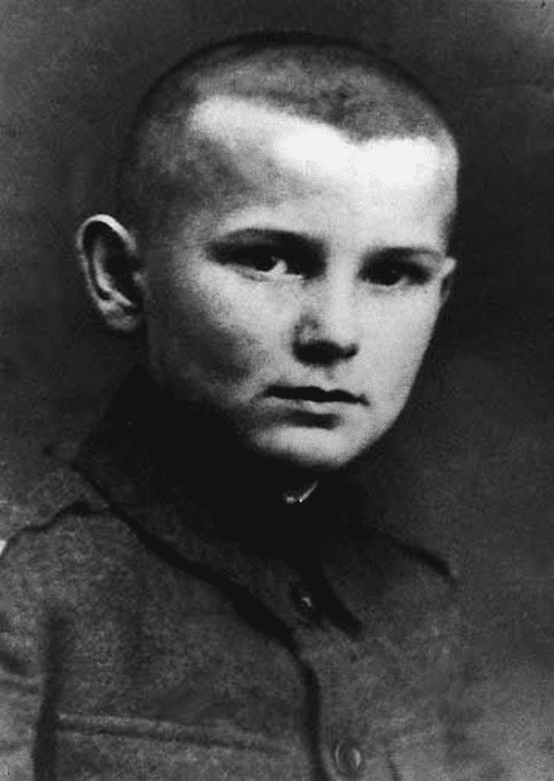
The life of Pope John Paul the Great was blessed with the sign of the cross from a very early age, I recall several testimonies that he left us in his many meetings with young people where, when answering their questions, he comments: “I was not yet at the age of first communion when I lost my mother, (in the year 1929) who did not have the joy of seeing the day she so awaited: she wanted two sons, one a doctor and the other a priest…”.[1]
Three years later, when Karol was 12 years old, he suffered the loss of his brother, who died due to an epidemic of scarlet fever, in the hospital where he began to work as a doctor (1932).
As a Polish citizen, he said: “I am the son of a nation that has lived through the greatest experiences in history, that has been condemned to death by its neighbors on several occasions, but has survived and remained itself.” [2]
“That September 1, 1939, will never fade from my memory: it was the first Friday of the month. I had gone to Wawel for confession. The cathedral was empty. It was, perhaps, the last time I could freely enter the church.” [3] “At that moment the shelling began. I was assisting in the celebration of Holy Mass under the bombardment and in the midst of the bursts of anti-aircraft fire.”
“I remember the holocaust of the Jews. I would say that Providence took me by the hand during the war. It was then that I discovered my vocation to the priesthood. It was precisely through the tragic experience of war that I found this path for my life. At the same time, however, I participated in the suffering of many people in my country and throughout Europe.” [4]
“If I think about my life, I can say that an unforgettable experience of danger and fear is undoubtedly that of war. I was not even twenty years old when the storm of World War II was unleashed on Europe and on the whole world, sowing fear of bombings, deportations, reprisals. I know what it means, unfortunately, to be afraid.” [5]
“In those years long ago, at a time when my homeland was being wounded by war and then by the totalitarian regime, I looked for meaning in my life. I found it in following the Lord Jesus.” [6].
“The horrors of the deportation of my Polish compatriots to the death camps have profoundly marked my existence. Since then, the mystery of man has occupied the primary place in my thoughts, feeling irresistibly impelled to advocate respect for every human being, supported in this action by the mystery of Christ, who is not only our God, but also the brother who brings us salvation.” [7]
On February 18, 1941, his father died and young Karol was left alone. Commenting on his father, he said: “The force of the blows he received had opened up in him an immense spiritual depth, his pain became prayer. The mere sight of him kneeling had a decisive influence on my younger years. He was so demanding of himself that he had no need to be demanding of his son: his example was enough to teach the sense of discipline and duty.” [8] “I remember that day perfectly: when I returned from work I found my father dead,” (that summer Karol had been transferred to work at the Solvay factory).
“If I look back on my youth, the youth of years of occupation, terrible years full of nightmares, I see that the source of that ‘starting force’ was precisely the Eucharist. And not only for me, but for many others and, perhaps, especially for those who had to face the most difficult conditions.” [9]
“In the autumn of 1942 I made the final decision to enter the seminary in Krakow, which operated clandestinely. I was received by the rector, the matter had to remain in the strictest secrecy, even from the people I loved most.” [10]
On February 29, 1944, a car ran Karol over, leaving him unconscious on the side of the road, he woke up later while already in hospital. Despite the serious injuries he managed to recover.
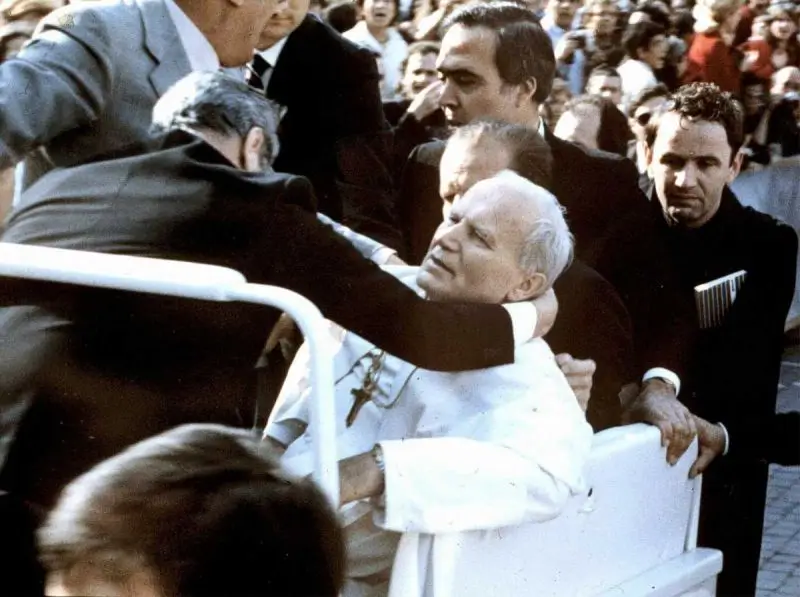
Many years later, already Pope, on May 13, 1981, he was the victim of an attempt on his life in St. Peter’s Square by Ali Agca. He underwent emergency surgery at the Gemelli hospital and after twenty-two days of hospitalization, on June 3 he was again back in the Vatican. A few days later, new health complications arose that forced him to remain hospitalized, finally on August 14 he was discharged.
“God has allowed me to experience, during these last few months of pain, the danger of losing my life. At the same time, I have been given the opportunity to understand clearly and completely that this is a special grace for me as a human being and, at the same time, in the context of the service I carry out, as Bishop of Rome and Successor of St. Peter.” [11] He attributed the miracle of surviving to the intervention of the Virgin of Fatima, who miraculously deflected an accurate fatal shot.
During his time in the hospital with the other patients, he addressed these words to them: “This is my strength, my strength is the Cross of Christ and the Cross of Christ is present in your suffering.”[12] Years later, a year before his death, speaking about the Eucharist, he commented: “To live on the Eucharist one must spend a lot of time in adoration before the Blessed Sacrament, this is a fact that I myself experience every day, finding strength, consolation and support in it.” [13]
At the end of his life, already afflicted by Parkinson’s disease, he trembled and had a poor ability to speak, even so, in spite of everything, on January 30, 2005 he read for the last time in person, the Sunday Angelus. That same night, he was admitted to the Gemelli hospital for a respiratory crisis and on February 10 he returned to the Vatican.
On February 24 he returned again to the Gemelli (now until March 13) where a tracheotomy was performed to resolve a situation of acute respiratory failure.
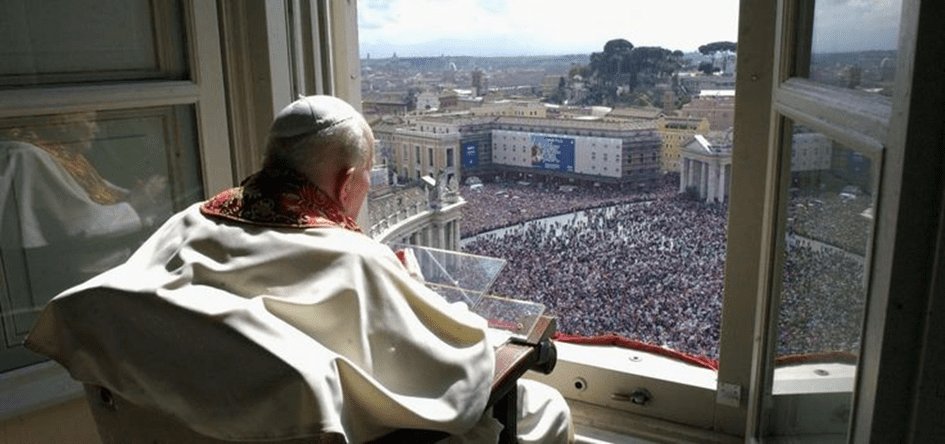
Even so, in this terrible state of health, on March 30, 2005, at the hour of the general audience, he appeared in the window of the apostolic palace to bless the thousands of pilgrims gathered in St. Peter’s Square.
It was his last public appearance, but despite the heroic attempt… he could no longer speak urbi et orbi… nor walk or move by his own means. From that last urbi et orbi message, Cardinal Dziwisz recalls some highly significant words to those who accompanied him in the moments before his “return to the Father’s house”, with difficulty in making out his words, he tells them: “Do not weep! I’m happy! Be happy!”
On his last Good Friday, during the Stations of the Cross, which he prayed daily, he could only take a crucifix and cling tightly to it. In his last days, prostrate but conscious, they said he looked at the image of the Ecce Homo hanging in his room. It was the one that best expressed the wonderful and luminous passages of Gaudium et Spes in which Cardinal Wojtyla had played a very important role at the time: “only in the mystery of the incarnate Word does the mystery of man take on light.” [14] And in another passage: “man…cannot fully find himself except through a sincere gift of himself.” [15].
Pains in the body, pains in the soul, physical sufferings, moral sufferings, sufferings for the Church… this Vicar of Christ incarnated in his person what he himself rightly called the “Gospel of suffering”.
There is no one better than his Secretary to share with us the profound interior life of St. John Paul the Great: “Without warning, he experienced penetrating pains, very strong, but which he bore with patience. He used to say that pain has a meaning, and not only did he say it, he lived it in his life with the truth, which is difficult to accept. He drank, therefore, from his personal experience when he wrote the apostolic letter Salvifici Doloris.” Indeed, after many years of pain and suffering, on February 11, 1984, he published the apostolic letter Salvici Doloris on the salvific value of human suffering.
St. John Paul the Great died on April 2, 2005, the first Saturday of the month and the first vespers of the Feast of Divine Mercy. He lived 84 years and was Pope for 26 and a half years.
Suffering in the Thought of St. John Paul II
“Wojtyla understood that in human beings suffering is simply inevitable. For this reason, he always had the conviction that the world of suffering – illnesses, moral pains of all kinds – and the suffering of the world – of war, of the loss of freedom – are a single mystery that only receives meaning in the light of Christ’s suffering.” [16]
Evil, an approach to an answer to suffering
“Man suffers whenever he experiences any kind of evil”[17]. It is evident that suffering is not pleasant, in fact St. Thomas Aquinas presents pain as a pole opposed to pleasure (cf. Summa Theologiae, I-II, qq. 35-39).
However, we regularly experience its intrusion into our lives and those we love most. Hence, at least, the question that can be made to the Author of life: why we suffer, and what meaning does suffering have in our lives. [18].
Suffering makes an evil clear to us and John Paul II significantly described that, “Sacred Scripture is a great book on suffering.” [19]
The Cross: The Answer to Suffering
“The evil of suffering, in the mystery of Christ’s redemption, is overcome and transformed: it becomes the force for the liberation from evil, for the victory of good”. [20] “The cross with Christ is the great revelation of the meaning of pain and the value it has in life and in history.” [21]
St. Thomas teaches that “through the cross of Christ there is manifested a divine self-emptying which has the power to overcome the devil and the world” (Commentary on the First Letter to the Corinthians, Chap. III, n.47). From this we can consider how “the cross invites us to respond to Love with love… The immense range of crosses, large and small, tend to merge into the one Cross.” [22]
“It is the cross with Christ that redeems. It is the only way of salvation and sanctification. To be holy, we cannot be exempted from suffering. Suffering is a necessary ingredient of holiness. As is love… that Christ teaches us and that… it is a crucified love, a love that atones and saves through suffering.” [23
“Suffering has no adequate explanation apart from God’s self-revelation to man on the Cross of Christ: Jesus changed the meaning of pain” [24].
In such a way that, “to understand the meaning of suffering, one must not look so much at sinful man, but rather at Christ Jesus, his Redeemer. In his human face a superior nobility is transparent. Christ realizes the ideal of man who, through suffering, brings the value of existence to the highest level.” [25]
A culture of non-suffering?
“In a society like today’s, which tries to build its future on well-being and consumerism and values everything according to efficiency and benefits, illness and suffering are removed or emptied of meaning, with the illusory attempt to overcome them only with the means made available by the progress of science and technology” [26], can we see that we are living in a culture of non-suffering and where suffering is totally meaningless.
“From this point of view, the Church has a good message to resonate within society and cultures that, having lost the sense of human suffering, they therefore also silence any way of talking about this harsh reality of life.” [27]
This “culture of non-suffering” is a form of “culture of death”: a man without God, an immanentist and atheistic humanism without hope. It contains an erroneous conception of what man is, which gradually loses meaning and of the meaning of life as well as at the same time as a consequence the resigning the meaning of suffering. For this reason, St. John Paul II himself did not hesitate to proclaim repeatedly that “man without God is not man.”
The Lord said, “Come unto me, all ye that labor and weary, and I will give you rest.” Union with Christ does not prevent us from suffering, from experiencing pain, to the point that in order to die, we must somehow resemble Him. For, with his redemption, he also redeemed all human suffering, thus giving meaning to the whole mystery of human existence.” [28]
“Suffering is particularly essential to man’s nature, because it manifests in its own way the depth proper to man and in some way surpasses him. It seems to belong to the transcendence of man: it is one of those points in which man is in a certain sense destined to surpass himself, and in a mysterious way he is called to do so…” [29]
“Jesus did not come to establish an earthly paradise, from which pain is excluded. Those who are most intimately attached to their destiny must accept suffering. However, it will end in joy. In the divine plan, all pain is the pain of childbirth; it contributes to the birth of a new humanity. Christ, in reconciling man with God through his sacrifice, has reconciled him with suffering, for the creation of a better world.” [30].
For all that has been said above, suffering is always a mystery, even if it is no longer definitive, even if it does not have the last word. A greater and tremendous mystery is that of the Incarnation of the Son of God, who, being God, freely assumed our human nature in order to be able to sacrifice this body, choosing the Cross as a means of salvation, as our way to Heaven, only in the Cross of Christ and intimately united to Christ do we find joy in our sufferings and our consolation. This is a great mystery.
“For man, in his suffering, remains an intangible mystery” (Salvicifi Doloris, n.4)
[1] André Frossard / Giovanni Paolo II “Non abbiate paura!”, Rusconi, 1983. (Translation by editor)
[2] Discurso del santo padre Juan Pablo II a la organización de las naciones unidas para la educación, la ciencia y la cultura – UNESCO* París, lunes 2 de junio de 1980 (Translation by editor)
[3] Gift and Mystery, n. 1
[4] Cf. speech of 15/09/87
[5] Cf. Speech of 18/05/96
[6] Cf. speech of 06/05/04
[7] Cf. speech of 18/02/82
[8] André Frossard / Giovanni Paolo II “Non abbiate paura!”, Rusconi, 1983
[9] Cf. speech of 10/06/87
[10] Gift and Mystery, n. 2
[11]Cf. speech of 10/14/81.
[12]Cf. speech of 29/08/82.
[13] Cf. speech of 19/04/04.
[14] Gaudium et Spes, n.22.
[15] Gaudium et Spes, n.24.
[16] Navarro-Valls, Joaquín: “John Paul II and the Mystery of Human Suffering”.
[17] Salvifici Doloris, n.7.
[18] Cf. Salvifici Doloris, n.9.
[19] Salvifici Doloris, n.6
[20] General Audience 9/11/1988.
[21] General Audience, 30/03/1983
[22] General Audience, 23/03/1983.
[23] Address to the sick in Turin, Italy, 4/9/1988.
[24] General Audience, 27/4/1983.
[25] Idem.
[26] Message for the World Day of the Sick, 1997.
[27] Apostolic Exhortation Christifideles Laici, n. 53.
[28] Homily to the Sick in Papua New Guinea, 8/5/1984
[29] Salvifici Doloris, n. 2.
[30]General Audience, 27/4/1983, n. 3.
Discover more from Friends of the Cross
Subscribe to get the latest posts sent to your email.